
 What's on
 Booking info
 Your Visit
 About Us
 Contact

The Organ
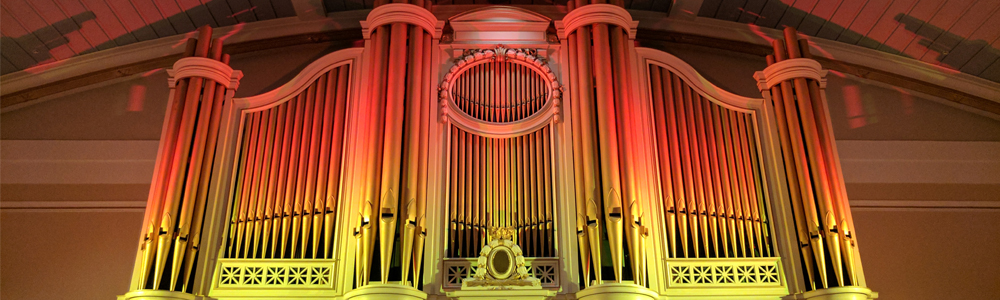
One element of the hall’s impressive resumé is our 6,000 pipe organ. This priceless work remains the only surviving example of the genius of Leicester’s Stephen Taylor and Sons Ltd.
This vast musical instrument was gifted to the public by Alfred Corah, the head of Leicester’s largest hosiery company, in February 1914. With its presentation and debut performance the hall was widely considered to have reached completion.
“I have pleasure in sending you the enclosed cheque in payment for the new organ at the De Montfort Hall. I consider your charges are most reasonable, and wish to assure you that the work has given me the greatest satisfaction – in fact it could not have been better had I gone to the first builders in London. All the great organists who have tried it are delighted with the instrument.” Alfred Corah
One of three of the city’s major pipe organs, the others can be found at Leicester Cathedral and nearby at the Church of St James the Greater.
The most historically significant of these instruments, the De Montfort Hall organ, is thought to be the only surviving example of a large concert organ, constructed by Stephen Taylor & Son Ltd. Its survival, refurbishment and significance was celebrated in a special birthday recital evening on Thursday 18 February 2004.
The company was founded in 1866, and were based in Severn Street, off London Road, in the city. The Taylor family had begun building organs as early as 1855 as represented by the organ at Scraptoft Parish Church. The company were absorbed by Walkers of York in the 1960s.
Quality was the hallmark of Taylor’s instruments. They were built of fine materials and were notable for their easy access for repair and maintenance. As such, it’s possible to walk through De Montfort Hall’s organ in order to access its 6,000 pipes.
Stephen Taylor, whose great-grandfather built the De Montfort Hall organ, took part in the 90th Anniversary Recital Evening. His grandfather was six years old when the organ was installed and crawled along the bass pipes while they were lying on the floor of the hall awaiting assembly.
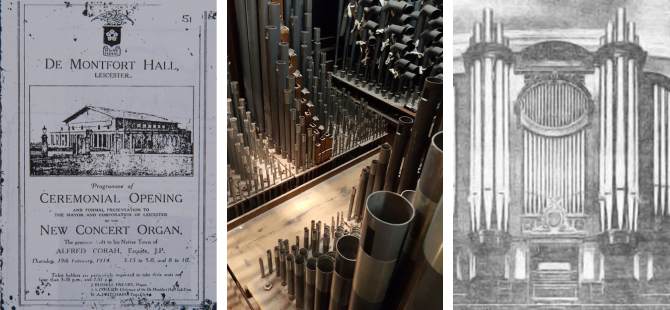
Part of De Montfort Hall was rebuilt in order to accommodate the organ’s larger pipes. The builders responsible for this work were Newby and Sons. Remarkably, the instrument had not been repaired or overhauled until its refurbishment in 1996. Consequently, it still has its original tracker action. Until around 1965, the organ was maintained by a contracted organ tuner in the Leicestershire village of Huncote.
It is thought that one of the conditions laid down by the Corah family was that a permanent civic organist be appointed – although this arrangement was never honoured.
The organ’s first recital in 1914 included Wagner’s Tannhauser, Brahms’ Hungarian Dance in F sharp minor, Rubenstein’s Russian Patrol, and Arthur Sullivan’s Brightly Dawns Our Wedding Day from The Mikado. Mrs Corah was the soloist in a performance of Elgar’s Land of Hope and Glory “with organ obbligato”. The evening commenced, of course, with the National Anthem, played by Alfred Corah himself.
Organs are “voiced” before installation, this essential work being carried out in a special Voicing Room. A highly skilled job, each voicer had his own hallmark which is recognisable even today. Geoffrey Burton Hollings worked as a senior tuner for Taylors and is remembered by many in the city as a skilled and talented organist and musician. Hollings worked for many years in schools in Leicester as a pianist and served as organist at the First Church of the Christian Scientist, just yards away from De Montfort Hall.
In a letter to the Taylor company written in January 1915, one distinguished organist wrote of Hollings’ work: “I was particularly struck with the artistic voicing and the tone generally, especially as regards the reeds which are beautifully round and smooth. I have seldom played on a more sympathetic instrument. My sincere congratulations upon a notable achievement.”
Restoration of the organ started in 1991 and was intended to be completed as part of the refurbishment of the hall which saw the tiered seating and lift installation. However, due to the sensitivity of the instrument the work could not be undertaken at the same time. When work began in February 1996, upon dismantling the organ it was discovered that there were serious defects and splits to the sound boards which resulted in much painstaking work to restore the sound quality to its former glory.
Humidifier units were installed to ensure that the sound boards will not dry out in future years. The metal pipes were cleaned in an ultrasonic bath and refurbished with new tuning slides and wires, with the weights being reset. The swell pipes were also removed and refurbished in a similar fashion. New wedges were installed where necessary and some electrical rewiring completed. The inaugural recital was given by Carlo Curley in April 1998.
Since its refurbishment the organ is played on a regular basis to maintain it and organ recitals are held to celebrate its magnificent sound.
Take a behind the scenes tour of our organ